


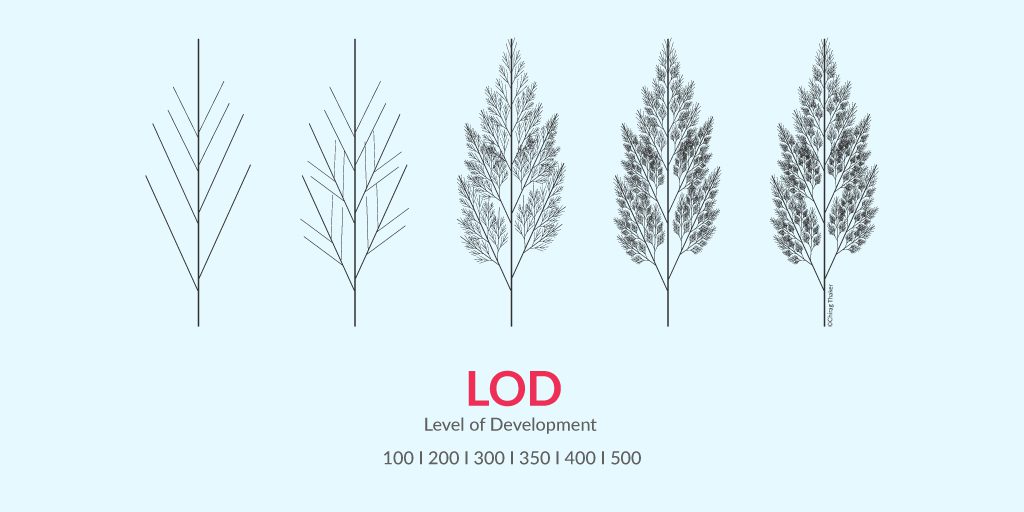
Level of development (LOD) is a set of specifications that gives professionals in the AEC industry the power to document, articulate and specify the content of BIM effectively and clearly. Serving as an industry standard, LOD defines the development stages of different systems in BIM. By using LOD specifications, architects, engineers, and other professionals can clearly communicate with each other without confusion for faster execution.
The Origin of LOD
LOD was first introduced by the American Institute of Architects (AIA) in 2008 when it defined five different levels of development to define the detailing levels in a BIM model. But the concept of LOD was present much before that.
The first instance of LOD usage can be traced to a construction analysis software company, Vico Software, which made use of the LOD-like system to associate digital models with the cost of a project. The company made all the parameters and details associated with a digital model accessible for everyone at various stages of the design process.
Now there are six levels of development with an addition of LOD 350 (details below) and it is seen that 80 to 90 percent of the elements in a model should at a minimum reach LOD 350.
What is Level of Development (LOD)?
Level of Development (LOD) specification allows professionals in the industry to articulate how an element’s geometry and associated information has evolved throughout the entire process. It signifies the degree to which different members of the team can rely on information associated with an element.
The LOD specification helps designers define the inherent characteristics of the elements in a model at different stages of development. The clarity in illustration gives depth to a model, signifying how much and at which level someone should rely on a model’s element.
Using LOD, designers and engineers can communicate with other professionals who will be using the model further about the usability and limitations of a model. LOD specifications were designed to standardize the use of the LOD framework and use it as an efficient and collaborative communication tool.
Level of Development vs. Level of Detail
LOD is usually interpreted as a Level of Detail instead of Level of Development. This specification uses the concept of Level of Development. There are important differences.
Level of Detail is actually what proportion detail is enclosed within the model element. Level of Development is the degree to which the components’ specification, geometry, and attached information have been thought through – the degree to which project team members may depend on the information when using the model. In essence, the Level of Detail can be thought of as input to the element, while the Level of Development is a reliable output.
LOD and Design Phase
The LOD doesn’t seem to be outlined deliberately by design phases. Rather, design phases completion, as well as any other milestone or deliverable, can be described through the LOD language. There are several important reasons for this approach:
1) The first reason is that there is no detailed standard available for the design phase. Earlier architects have created standards but existing within an organization. The standards differ from one organization to another, and it can even differ within a single organization according to the requirements of a project.
2) Building systems progress from concept to precise definition at different rates, so at any given time different elements will be at different points along with this progression. For example, after the Schematic Design phase, the model will include many elements at LOD 200, but will also include many at LOD 100, as well as some at LOD 300, and possibly even LOD 400.
Link : united-bim.com